Namo Amida Butsu
On July 18, I had the privilege of officiating a civil union ceremony at our temple for the second time in my ministry. I am deeply grateful for this precious opportunity and connection – an experience that likely would never have come my way had I not been serving as a minister of the Honpa Hongwanji Mission of Hawaii.
One of the partners is the granddaughter of a Wailuku Hongwanji member. Since childhood, she had visited the temple whenever her family came to Maui, so we were already acquainted. I met her again when her grandmother passed away a year and a half ago. After the funeral counseling, she introduced me to her partner. As we chatted, I mentioned that I had recently officiated a civil union ceremony and said, “If you are interested, you might consider having your wedding ceremony here at the temple.”
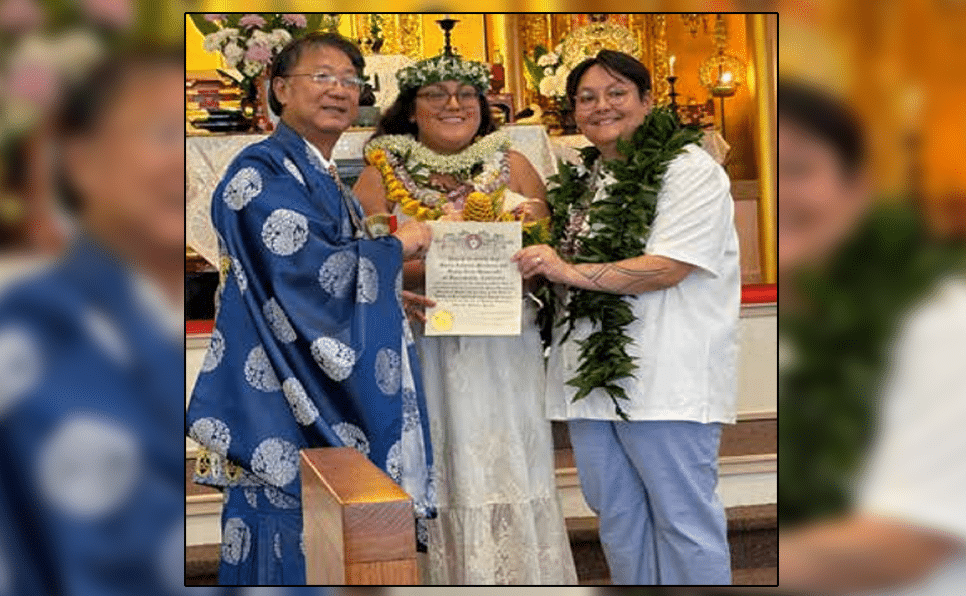
About six months later, they called and asked if I would officiate their wedding. I immediately replied, “Of course. I am sure your grandmother would be delighted. Please bring a photograph of her with you.” On July 18, surrounded by family and friends, the couple stood before Amida Buddha and exchanged their vows. Although already legally married in California, they wished to celebrate their marriage with the bride’s grandfather and relatives here on Maui. As I watched them exchange vows and rings, I saw the sincerity of their commitment to one another as lifelong partners.
After the ceremony, I introduced the newlyweds to the congregation. Amid warm applause, they walked down the aisle together. As I watched them receive everyone’s heartfelt blessings, I quietly said to myself, “May you be happy and always give your best to one another.”
I was once again reminded of how grateful I am to serve as a minister of the Honpa Hongwanji Mission of Hawaii. Had I remained in Japan, I doubt I would have had the opportunity to officiate a ceremony such as this. I could only express my gratitude through the words Okagesama de, “Thanks to the countless causes and conditions that support my life.”
Amida Buddha embraces all beings with absolute wisdom and boundless compassion. Whether or not one identifies as Buddhist, I believe it is a precious karmic connection that this couple, through their late grandmother and their relationship with Wailuku Hongwanji, encountered the teachings of Amida Buddha and made a vow to support one another throughout this irreplaceable life.
In the General Preface of the Kyogyoshinsho, Teaching, Practice, Faith, and Enlightenment, Shinran Shonin writes:
“Ah, this Great Vow is not something one encounters, no matter how many lifetimes one may live; nor is true faith something one attains, no matter how much time may pass. If, unexpectedly, one has attained this true practice and true faith, one should rejoice in the karmic connections stretching back from the distant past.”
It is my sincere hope that this couple will cherish the rare and precious bond they have encountered and continue their lives embraced by the warm light, profound wisdom, and boundless compassion of Amida Buddha. Congratulations, and may your journey together be filled with gratitude and joy.