Namo Amida Butsu
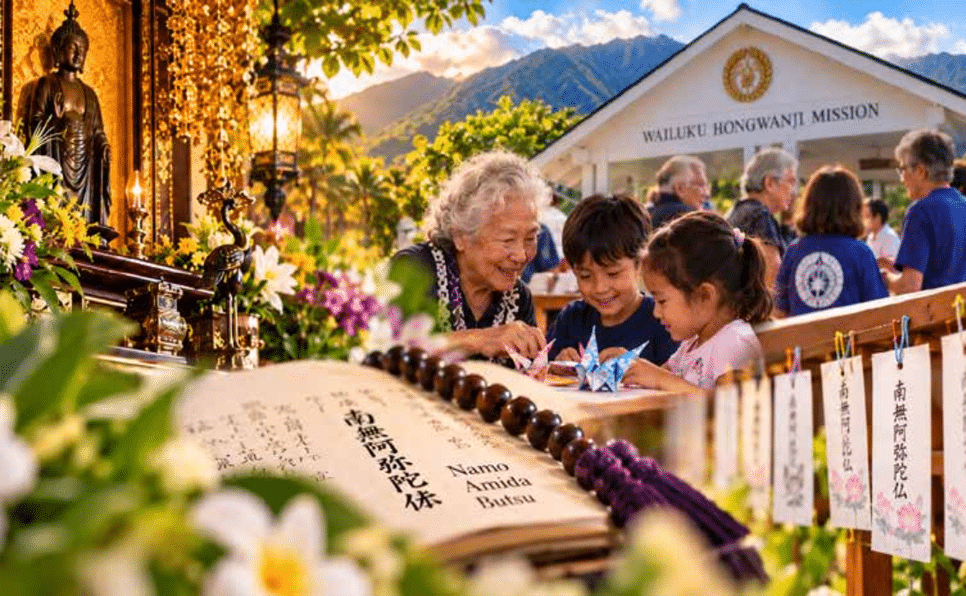
During November, many Buddhist temples observe their annual Sangha memorial services. In our Hongwanji tradition, this special service is called Eitaikyo, meaning “sutra chanting for generations.” It reminds us of the importance of receiving the Buddha’s precious teachings and passing them from one generation to the next. In Jodo Shinshu, memorial services are not conducted to benefit the deceased, but offer us, the living, opportunities to encounter the Buddha Dharma and reflect upon the countless lives and acts of kindness that have supported us.
One beautiful Japanese word our parents and grandparents often used is arigatai, meaning “deeply appreciated” or “truly grateful.” But when do we genuinely experience this feeling?
I once spoke with a second-generation Japanese American temple member who remembered growing up in poverty, experiencing discrimination, and working long hours in the sugarcane and pineapple fields. He told me, “Sensei, during those days, the only thing we could do was gaman—to endure and be patient. Those were difficult times. But today, looking back, I realize those hardships helped make me stronger. Arigatai desu yo. I am truly grateful.”
His words remind me of a story I heard from a Zen minister several years ago about a mother and her two young sons who lost their father in a traffic accident. Having lost their home and nearly everything they owned, they found shelter in a small room through the kindness of a friend. The children used apple boxes as desks while their mother worked long hours cleaning buildings and washing dishes to support them. After ten months of hardship, the mother was exhausted and losing hope. One morning, she left instructions for her older son, Takeshi, to prepare soybeans for dinner, explaining how to boil them and add two tablespoons of shoyu.
When she returned late that evening, her sons were asleep. Overwhelmed by despair, she had purchased sleeping pills, intending to end her life. But before taking them, she noticed a note her son had left on an apple box. “Dear Okaasan, I tried my best to cook the beans just as you told me. But my brother said they were too salty, so I added more water. Mom, I am sorry. Please teach me how to cook them as well as you do. No matter how early it is, please wake me up before you go to work. I know you must be very tired. I know you are working so hard for us.Arigato, Mom. Thank you for everything.”
As she read his words, tears filled her eyes. She realized how deeply her children loved her and how hard they, too, were trying. She picked up one of the beans and slowly tasted it. It was a little salty, but at that moment, her eyes were opened to the love that had surrounded her all along. She threw away the sleeping pills. Years later, she recalled that evening, saying, “Now I truly understand the meaning of arigatai and okagesamade. Without my son’s letter, I would not have realized how precious and wonderful my sons were.”
Sometimes what is most precious in our lives is already before us, yet we are unable to recognize it. Even when I hear the Buddha Dharma and appreciate Amida Buddha’s compassion, after only a short time, I forget. But Amida Buddha never stops reaching out to me. Amida Buddha never stops reaching out to you.
This is the great value of Eitaikyo. As we remember our parents, grandparents, teachers, and loved ones, we recognize the countless causes and conditions through which the Buddha Dharma has been passed down to us. Through listening to the teachings, the eyes of our hearts gradually open to Amida Buddha’s wisdom and compassion. When we place our hands together in gassho and recite Namo Amida Butsu, the Nembutsu arises as an expression of gratitude for the compassion that has always embraced us.
With grateful hearts, may we receive these precious teachings and pass them on to future generations