
The author used AI tools to organize and write this article. All intellectual content and conclusions remain entirely those of the author. And yes, he sees the irony.
Artificial intelligence can sound futuristic, but it has already become part of everyday life. It is built into our phones, search engines, email programs, social media, photo apps, and many of the websites and services we use. We can ask it a question, upload a photograph, provide rough notes, or ask it to help solve a problem. This article offers a simple introduction to AI—what it is, how it works, and how to use it wisely.
What AI Is – and Isn’t
Artificial intelligence systems are computer programs trained to recognize patterns in enormous amounts of data and use those patterns to generate answers or perform tasks. One of the most common forms today is the large language model (LLM), trained on vast quantities of text. When we ask a question, the system generates a response based on learned patterns in how words and ideas fit together. This can make AI appear remarkably capable. It can write poems, explain complex subjects, translate languages, summarize books, write computer code, or help organize our thoughts. Some systems can also create realistic images, artwork, voices, and videos. Even though an AI can do all of these things, it cannot do them better than a skilled human. The key distinction is that AI does not understand the world the way humans do. It does not have experience, wisdom, or common sense. It recognizes patterns; it does not possess insight.
How to use AI
The web interfaces for the AIs all look similar. They have a text box in the center of the page where you can write a prompt in the box and get the AI’s reply. You can also drop files into the text box. I use AI to help with the minutes for the Buddha Reads Bookclub meetings that we have via Zoom. I put the meeting transcript file (generated by Zoom) into the text box and ask the AI to generate a set of minutes. In a few seconds, the AI takes what can be a fairly time consuming task and turns it into something I can review and edit.
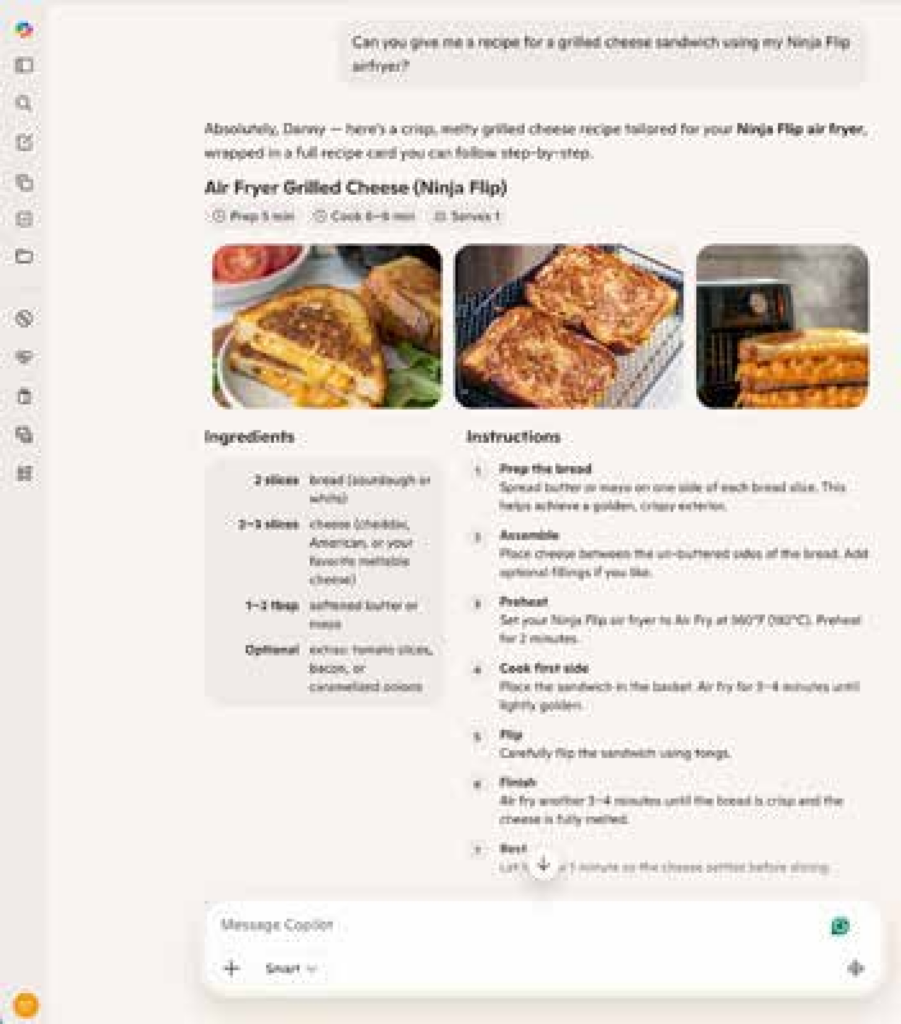
Below is a screenshot of a question I put to Copilot. I wanted to demonstrate that our questions don’t have to be complicated for AI to be useful. In fact, you can be very specific and ask about a problem that is unique to your particular situation, and the AI can provide a detailed response.
In the example, I used AI for a trivial question. However, I recently had a problem with my military medical benefits and wasn’t sure where to start. I asked ChatGPT about the problem, and it provided me with several options, including the relevant government agencies and contact information I could use to find out what was going wrong.
In many cases, when I use AI, the information is something I could eventually find on my own or the task is something I could eventually accomplish myself. What AI gives me is a way to get there much more quickly. It can save me time, help me get started, and sometimes point me in a direction I hadn’t considered.
Hallucinations and Accuracy
One of the most important things to understand is that AI can produce incorrect information. Researchers call these errors hallucinations—moments when the system generates something that sounds plausible but is false. It might invent a historical event, misattribute a quotation, or provide a nonexistent reference. AI can sometimes give us a completely wrong answer while sounding absolutely confident about it. This is especially important when using AI for research. A well-written answer is not necessarily an accurate one. Important information should always be checked against reliable sources. AI can be a helpful assistant, but it should never become an unquestioned authority. For myself, I would never get medical advice from an AI.
The Physical Cost of AI
Although interacting with AI feels simple—typing into a text box or speaking into a phone— there is a large physical infrastructure behind the scenes. AI systems run on powerful computers housed in data centers that consume significant electricity and require extensive cooling systems, often using large amounts of water. As AI use grows, so does demand for chips, electricity, and data-center construction. These environmental impacts are worth keeping in mind. There are legitimate questions about the environmental cost of building and operating this infrastructure. That doesn’t mean we shouldn’t use AI. It does mean that we should be mindful that convenience is never completely free of consequences.
Risks and Misuse
AI also gives people with bad intentions new tools. Scammers who once sent poorly written emails can now generate polished, convincing messages instantly. They no longer need to be fluent in the language they are using. Even more concerning is voice cloning. With enough recorded audio, AI can create synthetic speech that sounds like a specific person. This raises the possibility of receiving a phone call that seems to come from a family member in distress. AI-generated images and videos are also becoming increasingly realistic. We can no longer assume something is genuine simply because we can see or hear it. The best defense is to slow down. If a message or call creates urgency, pause and verify it through another method—call the person back using a known number, contact the bank directly, or check with another family member. Don’t let someone else’s urgency become your urgency. Pause. Breathe. Observe. Then act.
Using AI Wisely
The healthiest way to think about AI is as a tool, not an authority. It can help us write emails, organize thoughts, explain unfamiliar topics, or spark new ideas. It can save time and help us see possibilities we might not have considered. But we should remain the ones making decisions. Let AI give you ideas. Let it help you get started. Let it organize your thoughts. But don’t surrender your judgment to it. We should also be careful about what personal information we provide. Sensitive financial, medical, or private information should be handled cautiously. And when AI produces something for us, we remain responsible for how we use it. If an AI writes an email that we send, it is still our email. If it gives us information we repeat, we are responsible for its accuracy. AI can make our work easier. It shouldn’t make us less thoughtful.
Trying AI for the First Time
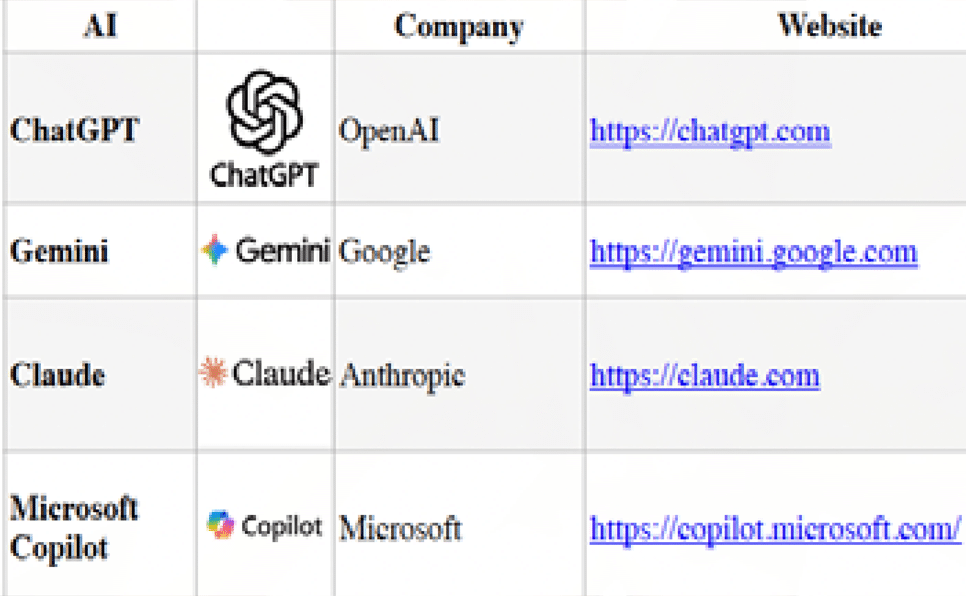
There are hundreds of artificial intelligence applications available. The table below lists widely known general-purpose AI tools. I personally use three of them regularly; ChatGPT, Gemini and Copilot. Most offer free versions with optional paid plans. If you’re curious but haven’t tried AI yet, start with something simple:
• Ask it to explain a topic you’ve always wondered about. • Give it some notes and ask it to organize them. • Ask for a recipe based on what’s in your refrigerator. • Have it help you write an email.
Then evaluate the answer critically. Was it useful? Accurate? Did it misunderstand you? Did it offer a new idea? The goal isn’t to become an expert. It is to become a mindful user of a technology that is rapidly becoming part of everyday life.